


Rectangle Rectangle Rectangle Rectangle Default


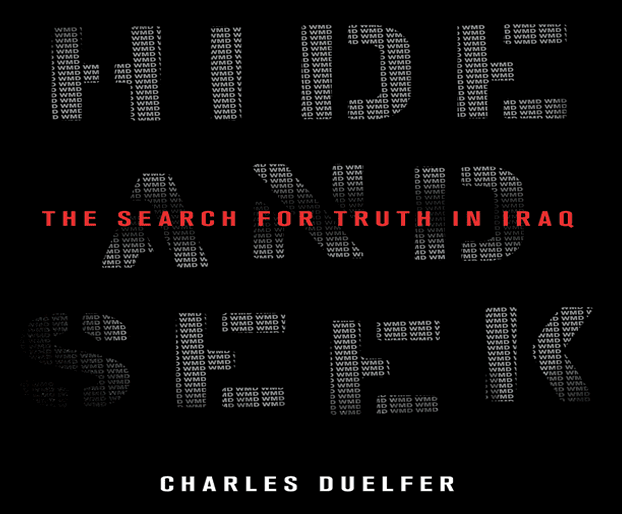
EXCERPTS FROM HIDE AND SEEK

Iraq didn’t need to be this bad.  Still, something had to be done.  That much is clear. (Page ix)

A colleague of mine, the only other person I knew who could drive from one side of Baghdad to the other without getting lost, said with bitter disillusionment about our own government, “We are finding, fixing, and eliminating all pockets of cooperation.”  This was less than three weeks after Baghdad had fallen. (Page 10)

In the end, it is the responsibility of political leaders to judge what to do with the intelligence community mechanism and its products.  The Bush administration was inclined to use the CIA assessments of Iraq WMD—assessments that were largely incorrect.  On the other hand, the administration chose not to use the largely accurate CIA intelligence and assessments of the political situation in Iraq, especially as they related to support for opposition groups and postwar reactions.  The administration also challenged the assessment that Saddam was not connected to al-Qaeda.  And although it used CIA covert operations to facilitate the removal of Saddam, the administration blocked the agency from using its internal resources and knowledge in replacing Saddam. (Page 471)

…In the case of Iraq, the question that emerges from this consideration is, “Was there any other way to remove Saddam?”  In this case, the answer, as described above, is yes, but the U.S. government is not sufficiently dexterous or focused to accomplish lower cost, longer-term solutions. 

The conclusion is that American leaders and the American people must assume that a foreign policy objective must be so important that it is worth doing very badly--because it is probable that the U.S. government will, in the event, do it very badly.  Good intentions are not enough.  Our good intentions, when acted upon, have done much damage. (Page xvi-xvii)

Sitting across the table for so many hours over so many years, I found it impossible not to consider that through the accident of birth, those on the other side of the table had to face decisions I had never confronted. Had I been born in Iraq and pursued an interest in public policy or engineering, what paths would have been open? If you were moderately successful, you would rise to a point where pursuit of your interest required an accommodation of some sort with the government. Do you continue with your career, incrementally becoming more deeply involved and indebted to the regime? ……The luxury of our choices was never more apparent.  (Page 94-95)

 “No, Amer, we can do what we want with GPS. This is the way we are building our baseline inventory of buildings for this survey. We have blocked the area in sections on imagery-derived line diagrams. We are registering data on each building according to each site and including its location.”

“We cannot accept that. You know full well your air force uses your UNSCOM data to bomb!” He had a point there, but the air force could have bombed without that data.

Getting louder, I shouted, “Look, General, do you really think the next satellite going over our heads doesn’t see exactly where on this pathetic planet this pile of Italian marble sits? If Washington gets it in its head it wants to blow up this place, it can do so without a bunch of UNSCOM inspectors!”(Page 147)

Overhead were both UNSCOM and Iraqi helicopters. At one point, the convoy pulled over to allow some laggards to catch up. It was evidently a very welcome opportunity for a large number of Iraqis to relieve themselves in the adjacent field. Probably a dozen were in the middle of the field generally pissing in the direction away from the road. An Iraqi MI-8 helicopter saw an opportunity and, before any of these Iraqis could react, swooped low over the field. The powerful downwash of the rotor had the desired effect on those in the field. The Iraqis were not without a sense of humor. (Page 150)

The extent of U.S.-Iraqi incomprehension was evident in a conversation I had with General Amer Rasheed while waiting outside a building in the Republican Palace area during the presidential palace inspections. The Iraqis had just built a freestanding wall about twenty feet high and thirty feet long set about twenty-five feet from the entrance to one palace building.

“General, may I ask you a question about this wall?”

“Yes, Mister Duelfer, of course,” he replied. We were both relaxed and killing time while inspectors toured the building.

“What is the purpose of the wall?”

Amer assumed I knew the answer already, but said, “Well, you know, we have carefully studied your cruise missiles, and we know they are targeted by images. We thought a wall would confuse the imagery guidance system and possibly…possibly cause the missile to either detonate early or not at all.” That sounded logical, it might even work.

“Well, maybe,” I admitted. “But that doesn’t help with bombs.”

Amer shrugged and then said, “May I ask you a question?”

“Sure.”

“Mister Duelfer, why do you always blow up buildings?” he asked seriously. 

Shrugging, I said, “It’s in our genes. We’re Americans, that’s what we do. We blow up buildings.” I was being facetious, but it was a fascinating question. Why do we always blow up buildings? One of the most interesting aspects of my work with the Iraqis was how much I learned of our own assumptions and characteristics, which, untouched by such a contrasting light or experience, go unnoticed.

We blow up buildings because our intelligence system is constructed around buildings. At its heart is an assumption that a building represents a capability or something of value. Satellites take pictures of facilities and photo-interpreters will assess the purposes of various buildings, be they hospitals, missile plants, or intelligence headquarters. Military campaigns designed to degrade the enemy’s capabilities are largely based on buildings. Images are digitized and put into the computer guidance systems of cruise missiles (or GPS coordinates are entered), and the missiles, or aircraft, bomb the buildings. Then we conduct “battle damage assessment” based on imagery of damaged buildings.

The Iraqis had figured this out and took measures to dissolve the images we could see. They simply moved equipment, documents, or other valuables and dispersed them outside the facilities. They could put valuable machine tools out in a field, and we would not notice or target them, because there was no building to attract our attention. (Page. 165-7)

… We got a couple of paper dishes of ice cream and ate them with plastic spoons, finishing them as we were driving passed more damaged buildings. I carefully, but awkwardly, put the empty cup, plastic spoon, and bunched-up paper napkin on the floor of the LandCruiser. The professor looked at me. Then he rolled down his window and tossed his cup out. I cringed momentarily. Littering. The professor glanced at me, reading my mind and I instantly saw the absurdity. We were passing some government buildings destroyed in the bombing. Looters were pulling down fencing around the buildings. The city was in chaos and I hesitated over a piece of litter. (Page 283)

In October 2003, a U.S. Army team conducted a raid based on intelligence that a senior former regime official was at a house not far from the Mansour neighborhood of Baghdad. As usual, in the middle of the night, soldiers surrounded the home using their night-vision gear, swiftly broke through the door, and swarmed in to secure the site and round up the inhabitants. They found only a terrified woman and two petrified girls. Their interpreter demanded to know where the men were, thinking they were hiding or had escaped.

The women answered in English; there were no men there. The soldiers challenged them saying they knew Nizar Hamdoon lived there and they wanted to know where he had gone. The last superpower had raided this home to capture a man who had died in Manhattan four months earlier after enduring six months of chemotherapy at Sloan-Kettering Hospital. The man they targeted had written and forwarded to the CPA a very insightful analysis of how a new government could evolve. Nevertheless, the last superpower sent soldiers to break down the door of his widow’s home—the same woman who had pleaded with the State Department representative at CPA to arrange some sort of passport to travel to the United States with her children to see him before he died.   (Page 329)

Everything appeared to go well until there was a huge explosion, which virtually leveled a building being searched. Watching imagery from surveillance, one can see two pulses of smoke appear—a small one followed by a huge puff that is eerily silent on video. The reality on the ground was of tension and adrenalin burst by an unexpected explosion—huge, which ignited not just the chemicals, but the latent anger in the neighborhood. Suddenly, this was not arms inspections; this was war—chaos, fire, burns, and a disorderly retreat to hospitals and safety. (Page 429)

Back in Washington, the bloom of hope that Saddam would reveal the location of WMD and that the insurgency would collapse in advance of the upcoming U.S. election wilted quickly. Saddam’s comments on WMD were terse. He said Iraq had none and added, “If you can locate a traitor to find me, why shouldn’t you find a traitor to locate WMD?” Saddam had some respect for U.S. and U.K. intelligence. In the fall of 2002, following the release of the a British “White Paper” describing Iraq WMD and following U.S. pronouncements about Iraqi possession of WMD, he was prompted to ask at an RCC meeting if anyone there was aware of capabilities that perhaps he, Saddam, was not. Could the CIA be right? Saddam was asking. The RCC members of course responded that such an event would be impossible, it would be impossible for Saddam not to know something…but Saddam was not so sure. (Page 390-1)

Saddam had revealed that one of his favorite books was Hemingway’s The Old Man and the Sea, a tale of a fisherman named Santiago who goes out alone and catches a large, beautiful fish, which he struggles to bring back before marauding sharks can decimate it. We did not want Saddam to slip into the role of Santiago. (Page 401)

I was pretty spun-up by the time I got there and started with a bit of a rant about the usual bureaucratic sludge you had to wade through to get anything out of the massive bureaucracy at MNF-I headquarters at Camp Victory. It was as if they had transplanted the entire Pentagon to a chunk of BIAP. It seemed like every useless colonel floating around the army was there so that he could require staff to write reports that they would then carry waddling up to general officers. These types never left the confines of Camp Victory, but would get credit for serving in the Iraq war. I continued on about large, useless, oxygen-wasting colonels. I was seated next to a very large and very muscular guy. And, like everyone in the room with the exception of Dayton, he was dressed in civilian clothing. A civilian, I stupidly assumed, even though the rest of McChrystal’s staff was dressed in civilian clothing. McChrystal, I thought, would be sympathetic to the issues of bureaucracy. His guys were not into process; they were into results. They did not even wear uniforms. He nodded in the direction of the massive guy next to me and said, “What’s your opinion on that, Colonel?” (Page 437)


Return to Top