|
|

|

|

|
 |
IRAQ is a case study of decision-making gone wrong. Although the Bush administration’s post-conflict choices—notably the de-Baathification order and the dismissing of the Iraqi army—are now widely acknowledged as wholly avoidable catastrophes, mistakes had been piling up for years. Many of them were made by Saddam Hussein’s government, long before the U.S. compounded them.
The saga of how the U.S. and Iraq misled each other into war, twice, and created an utterly unsustainable stand-off in between, has dominated our foreign policy for two decades. The lessons from it are vital, and should affect how future conflicts are appraised and managed so that we never enter such a thankless spiral of mutually assured antagonism again.
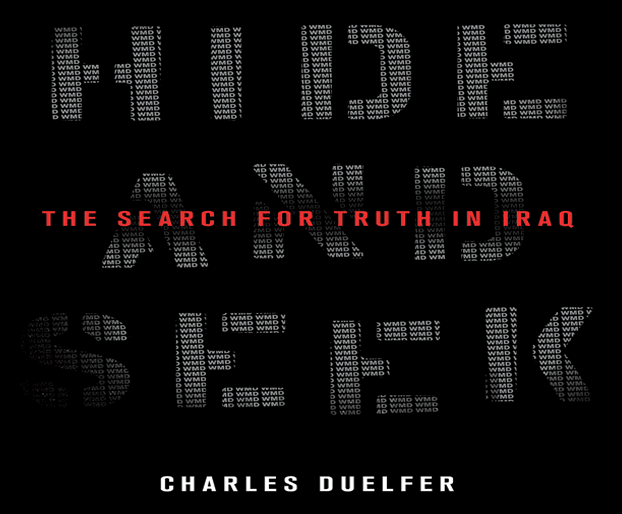
By 2000, Charles Duelfer knew Iraq perhaps better than anyone else in the U.S. government. The U.S. embassy in Baghdad had long been shuttered, trade with Iraq was forbidden under the terms of the UN sanctions, and, among the few people entering Iraq from the West were Duelfer and his UN arms inspectors. Duelfer knew, and maintained contact with, the top members of the Saddam regime. He had a better understanding of its weaknesses and phobias than any other American. He supervised the debriefing of Saddam Hussein after his capture, which he describes in detail here. Duelfer indentified a viable cadre of Iraqi officials within Baghdad who could have maintained government functions following the invasion in March 2003. It was Iraq’s tragedy that this course was not taken, and was, in fact, blocked. In 2004, President Bush entrusted Duelfer with the investigation of the Saddam regime and its WMD efforts, ultimately showing how the administration’s assumptions about WMD were flat-out wrong. That investigation would have cost Duelfer his life but for the intervention of a team of Kansas National Guardsmen, two of whom were killed preventing the suicide bomber from fully reaching his target.
Duelfer’s report to Congress in 2004 decrypted the Saddam regime and its WMD puzzle. It was an exhaustive description of arms inspection and intelligence collection. Here, Duelfer gives the back story. He shows how personal—in cost and consequence—good intelligence can be. It depends on good sources and good fieldwork. It cannot all be achieved remotely via a satellite link and a computer terminal. This book is Duelfer's testament to his hands-on experience of Iraq—as an intelligence test, a diplomatic dilemma, a vibrant and technically accomplisehd Arab state, a tyranny, and since 1991 the greatest challenge to America's global reputation. Here, for the first time, a distinguished American intelligence officer relates a uniquely personal, and difinitive, narrative of the misunderstandings and miscalculations that produced the colossal tragedy in Iraq.
|
The Duelfer Blog Latest Posts Why wouldn’t IRGC play Oil Futures? Saddam did in the 1990’s. Today’s volatility in oil markets and feverish trading in markets today reminds me of Saddam’s practices in the 1990’s. Oil reserves were very low. There were contentious political discussions in the UN Security Council concerning a relaxation of sanctions on Iraq oil … Continue reading Coercive Disarmament in Iran: 1991 Iraq Model The conflict with Iran will end with at least two elements: One will be some sort of political agreement to cease hostilities. Second will be an intrusive weapons inspection mechanism to account for the Iran nuclear program (and possibly other WMD … Continue reading |
|
|